 Restoration
Get involved
About us
Restoration
Get involved
About us
A Global Network of Organizations
About us
The Network
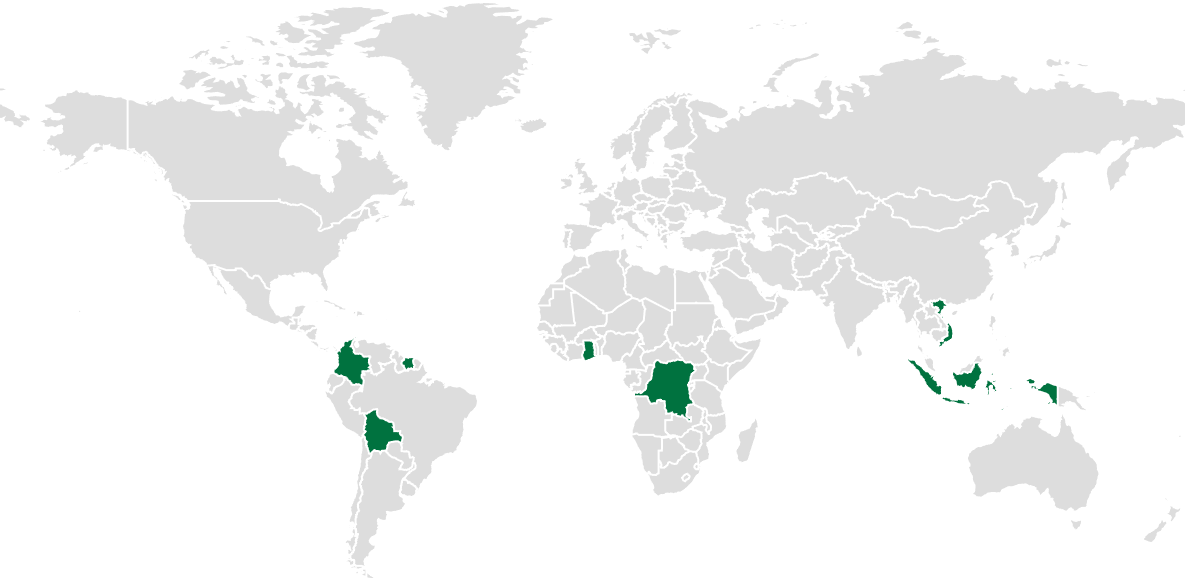
Tropenbos International (TBI) is a network of independent, locally governed organizations in Bolivia, Colombia, DR Congo, Ghana, Indonesia, Suriname, and Viet Nam, and a Network Hub based in the Netherlands. The network also includes partnerships in Ethiopia, the Philippines, and Uganda. All members share the same mission and work together toward common goals, guided by a joint strategy. This shared strategy promotes cross-country learning and comparative approaches to forest governance and sustainable land use. As a network, TBI contributes to international dialogues, and informs global decision-making for the benefit of people and forests.
About us
Accountability
We are committed to transparency, accountability, and high-quality work. We believe in fair and respectful treatment of all staff, partners, communities, and beneficiaries. To learn more, please refer to our policies:
- Integrity policy
- Anti-corruption and anti-fraud policy
- Sexual Exploitation, Abuse and Harassment (SEAH) Policy
- Whistleblower Policy
If you believe that Tropenbos International (TBI) staff or representatives have acted inappropriately or unfairly, please follow the procedure mentioned in our Integrity policy or Whistleblower Policy. You can file your complaint by sending it to integrity_officer@tropenbos.org. All complaints are dealt with confidentially and appropriate action will be taken. TBI is also committed to protecting your privacy. We explain what personal data we collect, why we collect it, and how we use it in our Privacy Statement. For questions about how we handle your personal information or comply with data protection laws, please contact us at tropenbos@tropenbos.org.
Organizational Information
- Registered name: Stichting Tropenbos International
- RSIN / fiscal number: 91.93.968
- ANBI status since 2008
- VAT number: 009193698B01
- Netherlands Chamber of Commerce number (KvK): 41155305
- Annual accounts: 2020 | 2021 | 2022 | 2023 | 2024
- Annual report: 2019 | 2020 | 2021 | 2022 | 2023 | 2024
- General Board
Restoration
The challenge
Globally, over one billion hectares of land are degraded due to unsustainable land use and wildfires. Many restoration effortsfail because they overlook community needs and therefore lack local support. Communities hold valuable knowledge on sustainable land use and have a direct interest in restoration. Enabling them to lead efforts can transform degraded land into resilient, productive ecosystemse with tangible local benefits
What we do
We support participatory and productive restoration by showcasing succesful example, ecouraging mutual learning, and promoting it’s adoption in development programmes. Our strategy is built around four key components:
- Sustainable livelihoods: We support local restoration initiatives - particularly those led by women and youth - that deliver both immediate and long-term livelihood benefits
- Diverse ecosystems: We work with local communities to restore areas using a variety of plants and trees, drawing on local knowledge of species best adapted to local conditions
- Inclusive governance: We empower local communities, particularly women and youth, to participate in restoration decision-making and advocate for their rights and needs.
- Supportive programmes and policies: We support local restoration initiatives - particularly those led by women and youth - that deliver both immediate and long-term livelihood benefits
Contact
To learn more about our initiatives or to collaborate with us, please contact Humberto Gómez at humberto.gomez@tropenbos.org
Get involved
Forests are at risk, and we believe in collective action to adress this global challenge.
We appreciate collaborations with public and private partners, including foundations, companies, research institutions, and other non-profits.
We offer:
- First-hand insights from research, field monitoring, and practical experience in forest frontier landscapes across the tropics.
- Connection to a diverse network of local partners and experts working in crititical landscapes in Latin America, Africa, and Southeast Asia.
- Opportunities to contribute to and visit innovative local initiatives that drive transformative change and support global climate and biodiversity goals.
Become a funding partner
We welcome partnerships with foundations, charities and companies that share our commitment to thriving, resilient and biodiverse landscapes in the forested tropics
Please contact Joost van Montfort, Executive Director, at joost.vanmontfort@tropenbos.org
Become a technical or programmatic partner
If you are a research institute, NGO or company working on tropical forest issues, we are open to exploring potential partnership opportunities to complement and enhance our shared impact. Please contact, Roderick Zagt, Head of Programmes, at roderick.zagt@tropenbos.org
Wildfire prevention
The challenge
Wildfires are a shared threat to people and nature. Driven by a combination of climate change and land-use practices, they are becoming more intense, frequent, and widespread.
The best way to avoid damage is to prevent wildfires from occurring in the first place. Since fires cross farm boundaries and impact entire ecosystems, prevention depends on coordinated efforts across the landscape and even entire regions. It requires communities and other actors to work together to improve fire management and land-use practices, using both local knowledge and science.
What we do
- Collective learning: We promote collective learning among landscape actors to build common understanding of wildfire risks and prevention, laying the groundwork for collective action.
- Empowered communities: We strengthen local capacities to prevent wildfires and support the implementation of integrated fire management practices, for example through community-led monitoring.
- Shared governance: We promote inclusive decision-making to prevent wildfires within a landscape, based on the principles of partnership, equity and accountability.
- Improved policies and practices: We inform policies to promote fire-smart practices through a combination of regulations and incentives.
Contact
To learn more about our initiatives or to collaborate with us, please contact Rosalien Jezeer at rosalien.jezeer@tropenbos.org or Humberto Gómez at humberto.gomez@tropenbos.org
Agroforestry
The challenge
The rapid expansion of export crops like palm oil and soy causes deforestation and biodiversity loss, and creates treeless monocultures that leaves farmers vulnerable to climate shocks and market volatility, threatening their long-term resilience.
Diversifying agriculture, for example by combining crops and trees in agroforestry systems, is key to resilience. With the right incentives and support in place, smallholders can benefit from these practices while avoiding further expansion into natural forests.
What we do
We support participatory and productive restoration by showcasing succesful example, ecouraging mutual learning, and promoting it’s adoption in development programmes. Our strategy is built around four key components:
- Sustainable land-use: We facilitate collaborative learning to develop sustainable agroforestry systems that can compete with monocultures, drawing on farmers’ priorities and knowledge - often preserved and passed down by women.
- Access to markets: We help smallholders strengthen their organizations, meet market standards, and connect with buyers, with a focus on youth- and women-led businesses. We also work with companies to make sustainable markets more accessible and to develop incentives for sustainable practices.
- Access to finance: We collaborate with financial institutions on innovative mechanisms that provide credit to small enterprises that want to invest in sustainable production.
- Supportive policies: We advise governments and support civil society advocacy efforts to shape national and international policies that create conditions and incentives for smallholder agroforestry and deforestation-free agriculture.
Contact
To learn more about our initiatives or to collaborate with us, please contact Jinke van Dam at agrocommodities@tropenbos.org
Biodiversity Bridges: Safeguarding biodiversity through locally led initiatives and ecological corridors in Bolivia and DR Congo
Overview
Wildfires are a shared threat to people and nature. Driven by a combination of climate change and land-use practices, they are becoming more intense, frequent, and widespread.
The best way to avoid damage is to prevent wildfires from occurring in the first place. Since fires cross farm boundaries and impact entire ecosystems, prevention depends on coordinated efforts across the landscape and even entire regions. It requires communities and other actors to work together to improve fire management and land-use practices, using both local knowledge and science.
What we focus on
- Connecting and protecting high-value habitats, including municipal reserves, community forest concessions, and areas under conservation zoning.
- Strengthening community forest management with clear biodiversity indicators and regular monitoring.
- Reducing fragmentation through sustainable production and land-use planning with Indigenous Peoples and local communities, including women and youth
- Building evidence and sharing lessons from field experience in ways that inform both practice and policy.
How we work
We co-design actions with Indigenous Peoples and Local Communities, municipal authorities and local organisations, to strengthen community forestry, land-use planning and multi-stakeholder governance. Cross-country learning, knowledge products and organisational support help scale proven approaches across both landscapes.
Where
Bolivia: The Indigenous territories of Lomerío and Monte Verde in the Chiquitanía region | Implementer: IBIF (overall lead).
DR Congo: Bafwasende landscape in Tshopo Province | Implementer: Tropenbos DR Congo
Network support
Tropenbos International, providing technical backstopping, knowledge management and communication support.
Duration and funder
2025 - 2028
Funded by DOB Ecology